musings | california 2015

DSC_0059The long haired boy–man walked straight into the ocean in all his clothes. He started at the edge of the sand and he walked and he walked and he walked and he walked. It was low tide, but he was persistent. The water was up to his ankles now, up to his knees, up to his chest, at his neck.  He seemed a mile out. His sweat dissolved into a salty oneness with endless sea.  I stood down the beach by the lifeguard tower, and watched. I wondered whether he would stop at all, and a tiny part of me worried that he would keep going, dragged down by the weight of the boundless. Just as I was determining whether I should call for help, he stopped. The waves lapped at his chin.  I was moored there, unable to tear my eyes away from this hairy, engulfed Jesus. I began to imagine all the people that he might be, all the stories that might be encompassed in this vast gesture of either genuine or complete surrender to nature, or don’t−care−because−I−physically−can’t capitulation. Or, wait.  Oh dear. Were those floating pants? Seaweed. False alarm.

Perhaps:

As a young boy, Harold had been brought up on a steady diet of polo and nice sweaters. By the age of eight, he was an impeccable dancer and Cotillion aficionado   (with a penchant for using words like penchant and aficionado).   Harold’s family was an incubator of politicians, and he was slated to take over the American west. At fifteen, his family moved to Wyoming because they wanted to give him the best shot at the senate. To “ensure that our western branch is suitably fortified.” One day at the end of an afternoon of baby kissing and handshaking and town hall rabble rousing, he looked down at his suitably folksy spit shined (with someone else’s spit, of course) boots, and began to cry. They were tears of rage and confusion. It was a strange moment. All of the sudden it was a realization that his entire existence had been scripted and crafted and molded. He took off his boots. He wondered of the barefoot life. He made a rash decision. Sneaking out the back of the gas station where the campaign bus had stopped, he grabbed his wallet, left his shoes, and determined not to look back until he knew, really knew, his unscripted life.  One day he reached the ocean, and saw no reason to stop at the waters’ edge. He had walked to the edge of the unknown.

Or:

Until he almost drowned, Enrico had been deep, deeply in love with water. Every sweltering day and balmy night of summer his mother said, “You, my dear, are a fish.” And this boyfish went on a rafting trip with his cousins. Idaho, Class IV. The afternoon sun winked on the water. These rapids should have been a joyous surge of splashy adrenaline. Instead, he found himself bouncing out of the rubber raft, caught in a whirling tumblerush of clearest water. He saw with perfect clarity its clarity, which seemed strange to him. Pebbles and twigs and the immense pressure and weight overcame him. The icy pings hit his chest as his head struggled to make sense of direction. His mind told him to stay calm, but his body reacted faster. The cold made it hard to breathe, and he felt his chest tighten. Breaths caught in his throat.  That moment kept coming back to him, years and years and years later. It would hit him in the bath. In the rain. In particularly dense fog. The pressure that made him feel as if at any moment his chest might explode. He was no longer a fish, and he skirted the threat by intricately crafting a life on land. And then there was today. Today, the day of his mother’s funeral.  “You my dear, are a fish.” It echoed in his brain and his mind wrapped around it and would not let it go. He left the crushingly, chokingly compiled grief with his aunts at the reception and walked walked walked walked until he felt the water surround him instead.  

Maybe:

Two weeks earlier, Charlie had been on a bus of roaming hippies. They had parked at the top of a hill in Golden Gate Park and built a massive slip n’ slide. It was a recipe for plastic burn, but honestly…why not? The San Fransisco fog had abated for a moment. It was refreshing, and so so so free. He sprinted towards the plastic sheet and, four somersaults and a monumental slide later, arrived LIBERATED, at the bottom. It was here he encountered three young onlookers. To them he said “LIFE! Is about participation! Take off your pants and embrace the slip n slide!” They giggled, considered the approaching dusk, and sought the warmth of a coffee shop instead. Or a BART station. Anything really.    Not long after, the community they had enjoyed had started slipping (so to speak) and Jeri’s temper, at the end, had ripped it to shreds. Luca, who owned the bus, had declared it the end of an era, and unceremoniously dumped everyone by the Mystery Spot in Santa Cruz to “discover the mystery of their futures.” After a few days of bumbling amazement at the glories of the power trees, the redwoods, he rideshared down the coast and had somehow found himself in Newport Beach. It was bizarre and sterile and he felt like it was some kind of crazy Stepford utopia that was about to come crashing ‘round his ears. So he decided to test his dreamself and walk deep, deep into the water. Trying to figure out if he was, in fact, awake. He needed to shake himself back to knowing feeling again.

But then again, it could be simple:

There was a college day party down the street. After too many drinks to be there or to think anything else, he had distantly heard, “Walk that way. Ocean breeze will help.” And he did. And he waited.


choose your own best adventurebuddy

 Scenario: a bus has just dropped off you and your friend in the middle of the Croatian wilderness. You walk down the path to the ranger station, and as bus rattles off into distance, you realize that Plitvice National Park’s North Entrance is closed, because it’s November. There’s a map, but you have no idea what the map’s scale is: the other entrance could be a mile away, or twenty. It might be closed. It’s quiet. Leaves rustle softly as they flutter down through the mist. As you calculate the hours until nightfall, and as a tiny voice in the back of your mind begins to wonder just how long you could survive on that chunk of bread you’ve nibbling at since morning, the reality of your situation hits.

Pick your next move.

1) You and your co-venturer realize the ridiculousness of your situation simultaneously. You look straight at each other and burst into uncontrollable laughter. Deciding to walk along the highway in the general direction of the backup ranger station,you joke (kind of) about hitching a ride from one of the occasional passing cars, and declare, “WHAT AN ADVENTURE!”

2) You collectively burst into tears, huddled on the forest floor, and begin counting down to your impending death.

3) Someone says “well this never would have happened if YOU hadn’t decided we should see the waterfalls.” The next thing you know, you’re in a full blown argument about whose fault it is that the park is closed in November. In your  bitter resentment, you refuse to speak to each other. Someone stomps off into the forest, never to be seen again.

Life is the ultimate choose-your-own-adventure, but let’s be real:  no sane traveler would pick choice two or three.

The thing is, we sometimes do.

By deciding to travel with a friend who doesn’t share your travel aspirations, your trip is 100% more likely to spontaneously combust. This is science. This is truth.  You’re suddenly angry and alone and in the middle of the Croatian wilderness.

So before you book that five month trek through Nepal with your best friend since birth, who you LOVE (and omigod we would have the best time just doing yoga and smoking weed and falling in love with sherpas), except she hates bugs, hiking, and meeting new people: stop. Hold up, wait a minute, and seriously consider your endgame, your goals. Do they match your co-adventurer’s? Be honest: do they match? It’s a simple question, but it’s the absolute most important to ask when you’re seeking to maximize the awesomeness of your next big adventure. It’s always better to know before you go. (And if you have a sudden epiphany that you and your bff would go batshit crazy  on a long trip with a gazillion variables: plan something easy and short, like, idk, a weekend in Cabo. Copious margs tend to solve these kinds of problems.)

Compare:

  1. What’s your budget? (It’s number one for a reason. Hugely important.)
  2. How much or little do you need to plan in order to be at ease?
  3. Related: how comfortable are you with change, and how willing are you to be flexible?
  4. How much sleep do you need? Are you on an early or late schedule?
  5. What’s your focus? (e.g. seeing ALL the sights, partying as much as possible, “relaxing,” catching every single pro soccer game on your route,  tanning for three months, celebrity stalking, intensive bird watching, etc.)
  6.  Where do you fall on the adventurousness scale?  I like to use a scale of wonderbread to skydiving, but to each her own.
  7. Need for showers? (aka your capacity for surviving with travel grit for a day or two while, for instance, climbing up an awesome mountain)
  8. How’s your cultural sensitivity? (or, how likely are you to dub a different way of doing something as “so backwards,” dismiss other cultures’ systems of politeness, or crack offensive jokes)
  9. How do you like to make decisions? By yourself? Collaboratively?
  10. How much/little do you need time alone while you travel?
  11. What’s your reaction in a crisis? (panic, call mom, find a solution, befriend the nearest police officer, etc.)
  12. How well do you compromise?

Compare notes, be honest with your goals and expectations, and when the unexpected knocks you off your feet (as it always does), you’ll laugh, and figure out how to get out of that hot mess together. Because that’s what travel soulmates/co–venturers do.

Full disclosure: Lest you think I’m a judgmental best-friend hater, making and keeping friends is one of my favorite activities and biggest priorities. It’s precisely because of this that I’m picky about my long-term travel buds. Trying to keep both my sanity and my friendships 🙂

movement | bedford, VA 2014

This is a story from a wonderful chef and  lover of food, Ron. It is written as remembered from his telling.

For these past twenty years, I have never lived more than six months in one place. I did a lot of things, worked in restaurants as a dishwasher and everything else, and later I would help get new restaurants started. For awhile I worked as a truck driver for Subway. I will never eat there again. We would deliver whole trucks of meat that had expiration dates in two years. Meaning the meat on your sandwich could be two years old. Eat fresh? I would see that on the TV and cringe. After that I was a Greyhound bus driver for a long time. On one trip across the country this lady and I got to talking. She was a southern belle out of Savannah, and we talked the whole ten hours.  We were getting close to the end of the line when she had been quiet for a few minutes. I looked over and saw such a look of consternation on her face.  

“What’s wrong?”

“I’m trying to figure out how to ask you out,” she said.

When the bus reached the end of its route we had a wonderful dinner together. Great conversation, great laughs, great moments. We were going different ways. We said goodbye.

Seven months later, I got off a Greyhound in LA. You’ll never believe this, but she was the first person I saw off the bus. Of all the places, of all the times. If these things are supposed to happen, they’ll happen. I walked right up to her and asked her if she wanted to get dinner. We had another perfect night together. Another perfect moment in time.

That’s not how Karen and I met, though.

We had both reached a point in our lives where we had entirely given up. We had both stopped looking, and resolved to live our lives alone. It was the last thing either of us were expecting. The short story? We went to tea. And then we each went home and thought ‘what the heck was that?’ And, we’re not monks.  We’ve been together for a year and a half now. This year, while I was packing to come here to camp for the summer, she said “you can leave things here, you know,” and I did. I left a whole drawer. I’m going back to Santa Barbara, and after all these years being in one place and another, it’s finally a place that feels like home, you know?

around the world in six weeks | bedford, VA 2014

We stood in a circle on the soccer field, beneath the stars. A girl stepped forward to speak. I was surprised, because the first few days of the program session, she barely spoke at all.  “I am so glad for these past two weeks, the friends I have made, and the experiences I have had here.  I know now that I am not alone.”

For that single moment, I knew that my summer spent working at the Global Youth Village had been beyond worth it.  Another participant stepped forward.

“I was in a bad mental place before I came here,” said a very bright young lady who never missed an opportunity to share. “Now I know I have the skills and the support so I can go out and produce positive things in my future. We have to go at it together.”

And another, his face brightened by candlelight, as he named every single one of us around the circle, and told us we would never be forgotten.

The next day, they were all going back to their homes across the world: Poland, Ghana, Taiwan, Japan, Libya, France, North Carolina, Virginia. Their fleeting community would be scattered.

Twelve days earlier, thirty high school students had arrived in the forest outside Bedford, Virginia.   For thirty five years, Legacy International’s longest running summer program has done the difficult work of bridging languages and cultures to enable intercultural understanding within its participant population, and give each young person the tools to spread that understanding within their home community. In my cabin, Salaam, my eight high school girls took a few days to warm up and become acclimated to camp life. There was bunking in a cabin to get used to,  the program’s culture of dialogue and sharing, and a camp’s typical cadre of spiders and creatures of the night.   There were four ESL learners in my cabin, and to be perfectly honest, that first day I was terrified.  On arrival day, I had spent hours asking every question I could think of (What do you do at school? What is your family like?  Tell me about your pets!) to fill the void–and to little response. The gap between those students and the rest of my cabin was like a gaping crevasse, and I felt like my brain was about to explode with the pressure to bring them all together as a community.  At that point, the only thoughts I could cohesively gather were “Tree? Bee!” Someone had been stung that first night, life was charades, and everything felt as if it were collapsing into a fiasco. But keeping it in perspective, I could not even begin to imagine how young Yu Zhe, who spoke not more than ten words of English, must have felt. “Trust the process,” I was told.  I laughed the delirious laugh of the exhausted, and asked for a hug.

Those first few days, I became a lot more comfortable with silence, something which I usually try to avoid at almost any cost. I knew, though, that they needed me to shut up so that they could take initiative with each other.  Slowly, slowly, slowly conversations started. “What is it like in Taiwan? Tell me about your school! You take the metro in Budapest? What kind of movies do you like to watch? Frozen!?  You know Frozen?! I LOVE Frozen. Cue the  “Let it Go” sing along.   And in those moments was the true beginning. I remember celebrating (like jumping up and down in the staff lounge celebrating) the day the silent one came down from her bunk to sit on the couch, and cautiously ask one of the Taiwanese girls for help with some characters. Contact!  My English speaking girls took a Chinese language and culture class, and soon started practicing with the native Mandarin speakers in my cabin, who taught them not just tones and pronunciation, but card games and a few favorite Chinese songs.They played guitar. They played  a uproariously silly game called Pterodactyl. They danced. They talked about boys and family and school and cultural whys and hows.  The cabin meeting on the fourth day was filled with laughter. Hun hao. Very good.

And on that last evening as we reflected on the nights of folk dancing, the days of discussions about gender,  Fukashima,  and the merits and pitfalls of ping pong and Justin Bieber songs, we blew out our candles. We sent our lights back to the stars.  Good night, goodbye, and I love you echoed through the night air in a tangle of languages swirling together to rest peacefully in one quiet understanding: friendship.  Trust the process.

nuit blanche  | paris 2011

1 October 2011

On Saturday, Paris stayed up all night in the name of art. All over the city, museums stayed open and from le Marais to Montmartre, 80 commissioned works were tucked into courtyards, displayed in the street, and projected on buildings. Nuit Blanche, or “White Night,” for Anglophones, is a once a year festival conceptually pioneered by Jean Blaise in Nantes as “Les Alumenees” in the 1980s and begun in Paris in 2002. Since then, it has inspired more than 120 similar festivals throughout Europe, Canada, and Australia.

Though Paris’ first Nuit Blanche was not without its difficulties, most notably the stabbing of mayor Bertrand Delanoë, on this, it’s tenth anniversary, the biggest problem is squeezing into metro cars.  An estimated 2.5 million cultural revelers roamed both underground and the packed streets in the participating quartiers, and they did so with joie de vivre. On an unseasonably warm night, surrounded by incredible works literally around every corner, it was hard not to make friends

L’experience, in photos:

 L’Hôtel d’Albret, Le Marais, 8 p.m.

Pierre Ardouvin’s participatory ,Prince-inspired “Purple Rain” exhibit  brought the song to life as it transformed Hôtel d’Albret into a pulsating, sensory purple storm of music and color. For those who braved the long entry line (at peak hours more than three blocks long) the reward was living a long awaited dream, umbrellas included.

Le Marais, 9 p.m

image

Le Marais, 10 p.m

image

Rue Du Temple, Le Marais, Midnight

image

  Metro at Montmartre/Anvers, 3 a.m.

image


on being laowai in china | shanghai 2012

tumblr_n1akvjXDYO1ttab3vo1_r1_540.jpg 

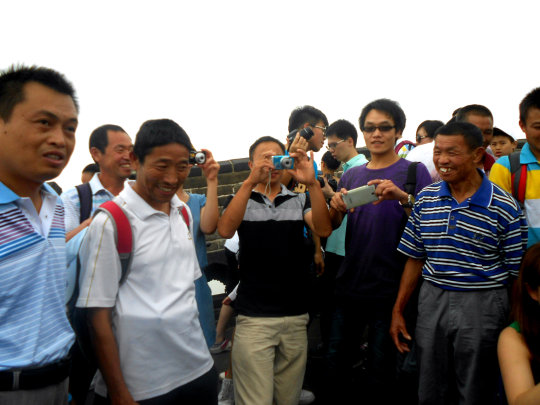
To be recognizably not Chinese, or a “foreigner” (laowai) in China is, in many ways, to be a circus act.  From Shanghai’s Bund to the Great Wall, parents pushed their frightened children (some, legitimately crying) towards my fellow travelers and I as they gestured requests for pictures. This was an almost daily occurrence, and the paparazzi phenomenon has been noted by most every visitor whose appearance is decidedly not Chinese. It’s hard to ignore sudden red−carpet treatment. While among urbanites this practice has decreased markedly in the past few years as westerners have grown more ubiquitous, the practice is still very much alive among tourists visiting from China’s more removed rural areas. And the fact that there are more tourists visiting from those areas? This is new. Travel in Maoist China was extremely difficult, due to the household registration, or hukou, system, as well as the lack of leisure time and lack of disposable income of the average Chinese. Until the reforms of 1978 and the beginnings of Deng Xiaoping’s more liberal policies, this system essentially tied Chinese citizens to their place of residence.  Even after political release from the trappings of residency,it wasn’t until the early 1990s and the increased liberalization of the Chinese markets, that more than a few had the financial means to travel.

As the markets have opened and capitalistic and materialistic values gained hold in China in recent years, domestic and international tourism has boomed. According to 2005 statistics from the China National Tourist Office, the tourism industry is “one of the fastest growing sectors of the Chinese economy.” Tour buses signal the rise of a new class of domestic tourists. For many, travel is another way to display rank and social position, the same mentality that drives the sale of designer handbags.  Photos, in this context, (of sights and of unsuspecting laowai) are trophies.

For Leo Zhuzheng, a construction worker who emigrated from rural China to Shanghai, travel is yet a distant dream. During our conversation at ECNU’s “English corner,” he said that he wants to travel more, to see more of his country. He is steadfast in the conviction, however, that travel is only possible for the rich “It’s another way to show you’ve got money,“ he says. For those less solvent, the industry represents an opportunity for profit.  As of this year, the tourist market is worth an officially cited $29,296,000,000 annually, and this has stoked the designation of ticketed “sights ” throughout the country.  Tickets of  for temples, traditional towns, monasteries, historical neighborhoods, buildings, walls, monuments, museums, jade factories, silk factories, acrobatic shows, gardens and “traditional” tea houses, to name a few, are amassed throughout the experience of “sight-seeing” in China. Tripadvisor.com cites 953 tourist attractions in Shanghai alone. More significant than mere mementos, tickets are representations of the commodification and commercialization that has grown as the market for tourists seeking these experiences has developed. The labeling and marketing of these cultural aspects and places (sometimes whole towns) as ticketed “tourist attractions” is not motivated only by individuals seeking profit,  as in a typical capitalist economy. Instead, the tourist market and the tourism infrastructure in China is a microcosm of the way that the Chinese mixed economic system functions.

Though driven by the modern motivations of the new open market economy and the capitalist motives of profit-making, the communist government maximizes profits from tourism by utilizing the centralized power and vast amount of resources it attained during the Maoist era. New hotel and restaurant standards have been implemented, and plans for Shanghai as a city to boost the number of tailored tours for everything from shopping to cultural heritage are in the works. The cost of this commercialization? While it is hotly debated whether this cultural commodification has devalued “authentic” culture, the one sure result is more crowds, and more waiting. As 12 year old Shanghai student Vivian Lee put it as she described her experience at the Great Wall’s tourist center of Badaling, there were “so many people… I could only walk like I was in a line. Move a little bit, and then a little bit more.”  After being herded along with the masses, the tour guide left her and her family only enough time to snap a few photos at the top before being whisked down to spend some quality time at the gift shop. She still saved that ticket, though, and she prizes her photos from the hour long trip to the Great Wall. As she asks to take a photo with me, the most convenient laowai, it’s another feather in her cap.

in the market for marriage | shanghai, 2012

“It’s a truth universally acknowledged, that a single man in possession of a good fortune must be in want of a wife.”   Jane Austen

tumblr_n1ak5iD8Et1ttab3vo1_540.jpg

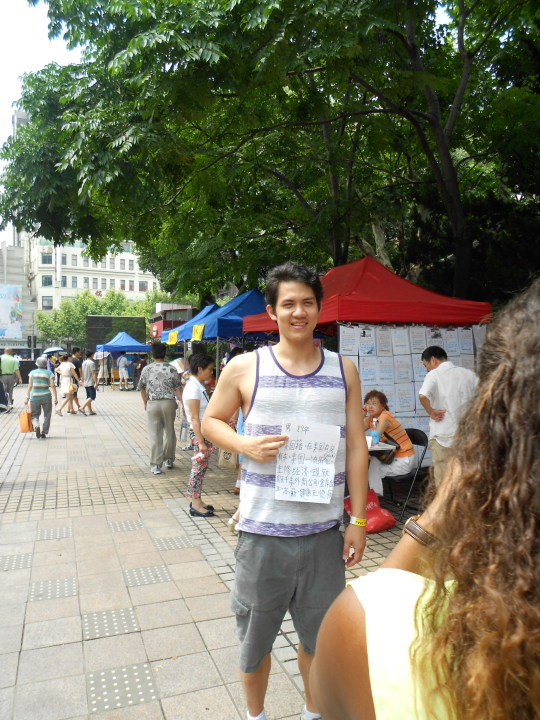
It’s the conceptual mantra of thousands who flock to Shanghai’s People’s Park each weekend. On Saturdays and Sundays, this bustling bit of the city center transforms into a live marriage market. Thousands of advertisements hang from canopies and cover the walls of tunnels throughout the park as parents tout their children’s eligibility for marriage: height, weight, age, economic security.  For eligible bachelors and bachelorettes, enthusiastic crowds of mothers, fathers, aunts, and grandparents spring up instantaneously, offering proposals and urging the unmarried to make further plans with their families. Combined with the pop up enterprises offering to find the best matches, and draw up contracts on the spot, it’s as if an extreme version of online dating has come to life.

tumblr_n1ak5iD8Et1ttab3vo2_540.jpg

For visiting American student Jason Wang, this particular Sunday afternoon at People’s Park is an experiment. Armed with a sheet of paper detailing his appealing attributes (age, income, American citizenship), he set up shop with Enid Zhou and Emily Chang, his classmates who acted as interpreters. “We’re like his Chinese parents,” they said.

tumblr_n1ak5iD8Et1ttab3vo3_r1_540.jpg

Within minutes,  a crowd began to gather. Half an hour later, he was entirely encircled, and having received a number of serious offers, he decided it would be unfair to continue to lead them on. “Especially as an American, I’m a catch,” Wang said, laughing. “Really the only question was “Why are you so young? If I stayed too much longer I might have left with a promise I wouldn’t be able to keep.”