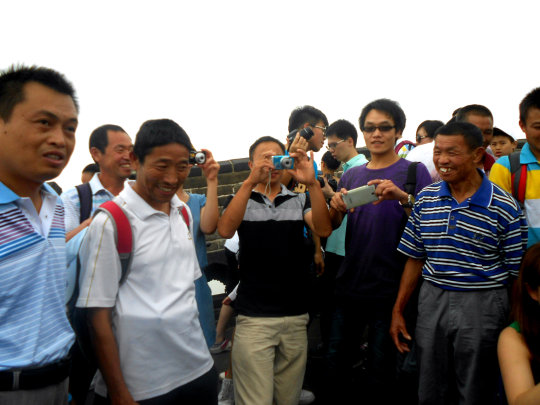
To be recognizably not Chinese, or a “foreigner” (laowai) in China is, in many ways, to be a circus act. From Shanghai’s Bund to the Great Wall, parents pushed their frightened children (some, legitimately crying) towards my fellow travelers and I as they gestured requests for pictures. This was an almost daily occurrence, and the paparazzi phenomenon has been noted by most every visitor whose appearance is decidedly not Chinese. It’s hard to ignore sudden red−carpet treatment. While among urbanites this practice has decreased markedly in the past few years as westerners have grown more ubiquitous, the practice is still very much alive among tourists visiting from China’s more removed rural areas. And the fact that there are more tourists visiting from those areas? This is new. Travel in Maoist China was extremely difficult, due to the household registration, or hukou, system, as well as the lack of leisure time and lack of disposable income of the average Chinese. Until the reforms of 1978 and the beginnings of Deng Xiaoping’s more liberal policies, this system essentially tied Chinese citizens to their place of residence. Even after political release from the trappings of residency,it wasn’t until the early 1990s and the increased liberalization of the Chinese markets, that more than a few had the financial means to travel.

As the markets have opened and capitalistic and materialistic values gained hold in China in recent years, domestic and international tourism has boomed. According to 2005 statistics from the China National Tourist Office, the tourism industry is “one of the fastest growing sectors of the Chinese economy.” Tour buses signal the rise of a new class of domestic tourists. For many, travel is another way to display rank and social position, the same mentality that drives the sale of designer handbags. Photos, in this context, (of sights and of unsuspecting laowai) are trophies.
For Leo Zhuzheng, a construction worker who emigrated from rural China to Shanghai, travel is yet a distant dream. During our conversation at ECNU’s “English corner,” he said that he wants to travel more, to see more of his country. He is steadfast in the conviction, however, that travel is only possible for the rich “It’s another way to show you’ve got money,“ he says. For those less solvent, the industry represents an opportunity for profit. As of this year, the tourist market is worth an officially cited $29,296,000,000 annually, and this has stoked the designation of ticketed “sights ” throughout the country. Tickets of for temples, traditional towns, monasteries, historical neighborhoods, buildings, walls, monuments, museums, jade factories, silk factories, acrobatic shows, gardens and “traditional” tea houses, to name a few, are amassed throughout the experience of “sight-seeing” in China. Tripadvisor.com cites 953 tourist attractions in Shanghai alone. More significant than mere mementos, tickets are representations of the commodification and commercialization that has grown as the market for tourists seeking these experiences has developed. The labeling and marketing of these cultural aspects and places (sometimes whole towns) as ticketed “tourist attractions” is not motivated only by individuals seeking profit, as in a typical capitalist economy. Instead, the tourist market and the tourism infrastructure in China is a microcosm of the way that the Chinese mixed economic system functions.

Though driven by the modern motivations of the new open market economy and the capitalist motives of profit-making, the communist government maximizes profits from tourism by utilizing the centralized power and vast amount of resources it attained during the Maoist era. New hotel and restaurant standards have been implemented, and plans for Shanghai as a city to boost the number of tailored tours for everything from shopping to cultural heritage are in the works. The cost of this commercialization? While it is hotly debated whether this cultural commodification has devalued “authentic” culture, the one sure result is more crowds, and more waiting. As 12 year old Shanghai student Vivian Lee put it as she described her experience at the Great Wall’s tourist center of Badaling, there were “so many people… I could only walk like I was in a line. Move a little bit, and then a little bit more.” After being herded along with the masses, the tour guide left her and her family only enough time to snap a few photos at the top before being whisked down to spend some quality time at the gift shop. She still saved that ticket, though, and she prizes her photos from the hour long trip to the Great Wall. As she asks to take a photo with me, the most convenient laowai, it’s another feather in her cap.


 christinezirneklis.com